Demo Heading for an Article With Photo
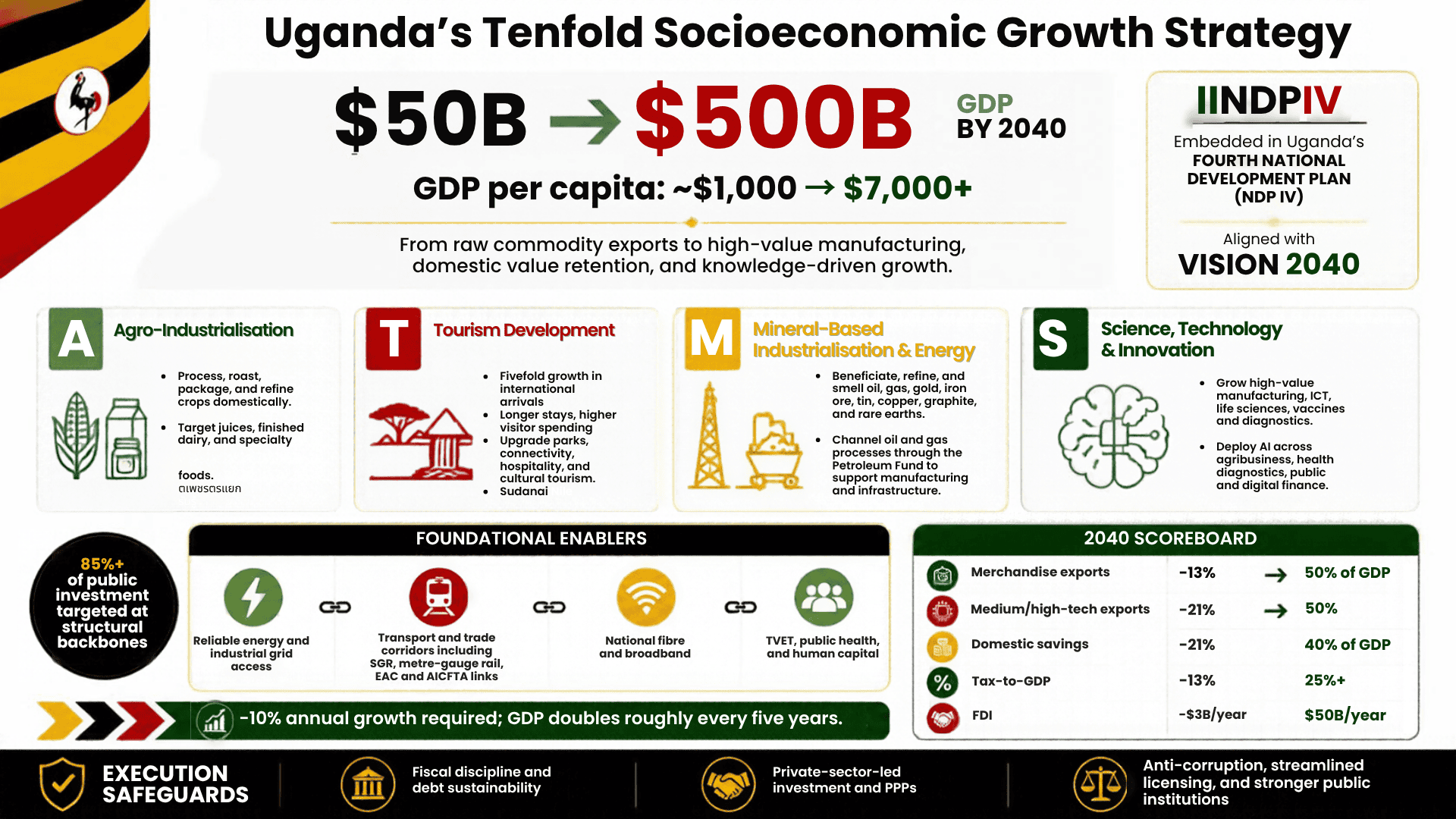
Uganda’s Tenfold Socioeconomic Growth Strategy is designed to expand the national economy tenfold—from approximately $50 billion to $500 billion by 2040, raising GDP per capita from around $1,000 to over $7,000. Embedded primarily within Uganda’s Fourth National Development Plan (NDP IV) and aligned with Vision 2040, the strategy moves away from exporting raw commodities toward high-value manufacturing, domestic value retention, and knowledge-driven growth.
The core framework is structured around four primary growth engines (known as ATMS) supported by macroeconomic and structural enablers
1. The Four Anchor Engines (ATMS)
A – Agro-Industrialisation:
Transitioning commercial agriculture from exporting raw crops (such as green coffee beans, tea, and grains) to domestic processing, roasting, packaging, and refining.
Targeting high-value agro-processing (juices, finished dairy, specialty foods) to build domestic agro-industrial jobs and insulate export earnings from global commodity volatility.
T – Tourism Development:
Targeting a fivefold increase in international visitor arrivals alongside longer stays and higher expenditure per visitor.
Upgrading conservation-grade connectivity, national park infrastructure, regional hospitality services, and cultural tourism offerings.
M – Mineral-Based Industrialisation & Energy:
Developing domestic beneficiation, refining, and smelting for oil, gas, gold, iron ore, and critical transition minerals (such as tin, copper, graphite, and rare earths) rather than exporting raw ores.
Channeling proceeds from upstream oil and gas production into the Petroleum Fund to capitalize domestic manufacturing and physical infrastructure.
S – Science, Technology & Innovation (STI):
Fostering high-value manufacturing, ICT services, and life sciences (including local vaccine and diagnostics production).
Deploying the Uganda AI Vision 2040 framework across agriculture, healthcare diagnostics, public administration, and digital financial systems.
2. Foundational Enablers & Infrastructure
To support high productivity in the anchor sectors, over 85% of public investment under the framework is targeted toward these structural backbones:
Energy Generation & Grid Reliability: Expanding generation capacity and industrial grid access to lower per-unit electricity tariffs for manufacturing hubs and industrial parks.
Transport & Trade Corridors: Standard Gauge Railway (SGR) connectivity, rehabilitation of the metre-gauge railway network, and regional trade corridors linking Uganda with the wider East African Community (EAC) and AfCFTA markets.
Digital Connectivity: Expanding national fiber optic backbones and broadband coverage to support the digital services and fintech sectors.
Human Capital Development: Aligning technical and vocational education and training (TVET) with industrial needs, alongside public health improvements to enhance labor productivity.
3. Macroeconomic Targets & Financial Reforms
Sustaining the ~10% annual economic expansion required to double GDP roughly every five years relies on several financial metrics:
Metric Baseline (approx.) 2040 Target
Gross Domestic Product (GDP) ~$50–$53 Billion $500 Billion
GDP Per Capita ~$1,039 $7,000+
Merchandise Exports (% of GDP) ~13% 50%
Medium/High-Tech Exports ~21% 50%
Domestic Savings Rate ~21% of GDP 40% of GDP
Tax-to-GDP Ratio ~13% 25%+
Foreign Direct Investment (FDI) ~$3 Billion/yr $50 Billion/yr
4. Governance and Execution Preconditions
For the strategy to take effect without triggering macro fiscal stress, the government emphasizes several execution safeguards:
Fiscal Discipline & Debt Sustainability: Prioritizing productive, high-return public assets over recurrent expenditures or speculative construction.
Private-Sector Led Investment: Relying on public-private partnerships (PPPs) and clear regulatory stability to mobilize private capital rather than solely accumulating sovereign debt.
Anti-Corruption & Administrative Coherence: Streamlining bureaucratic licensing and reinforcing institutional capacity across ministries, departments, and agencies (MDAs).