-
Demo Heading for an Article With Photo
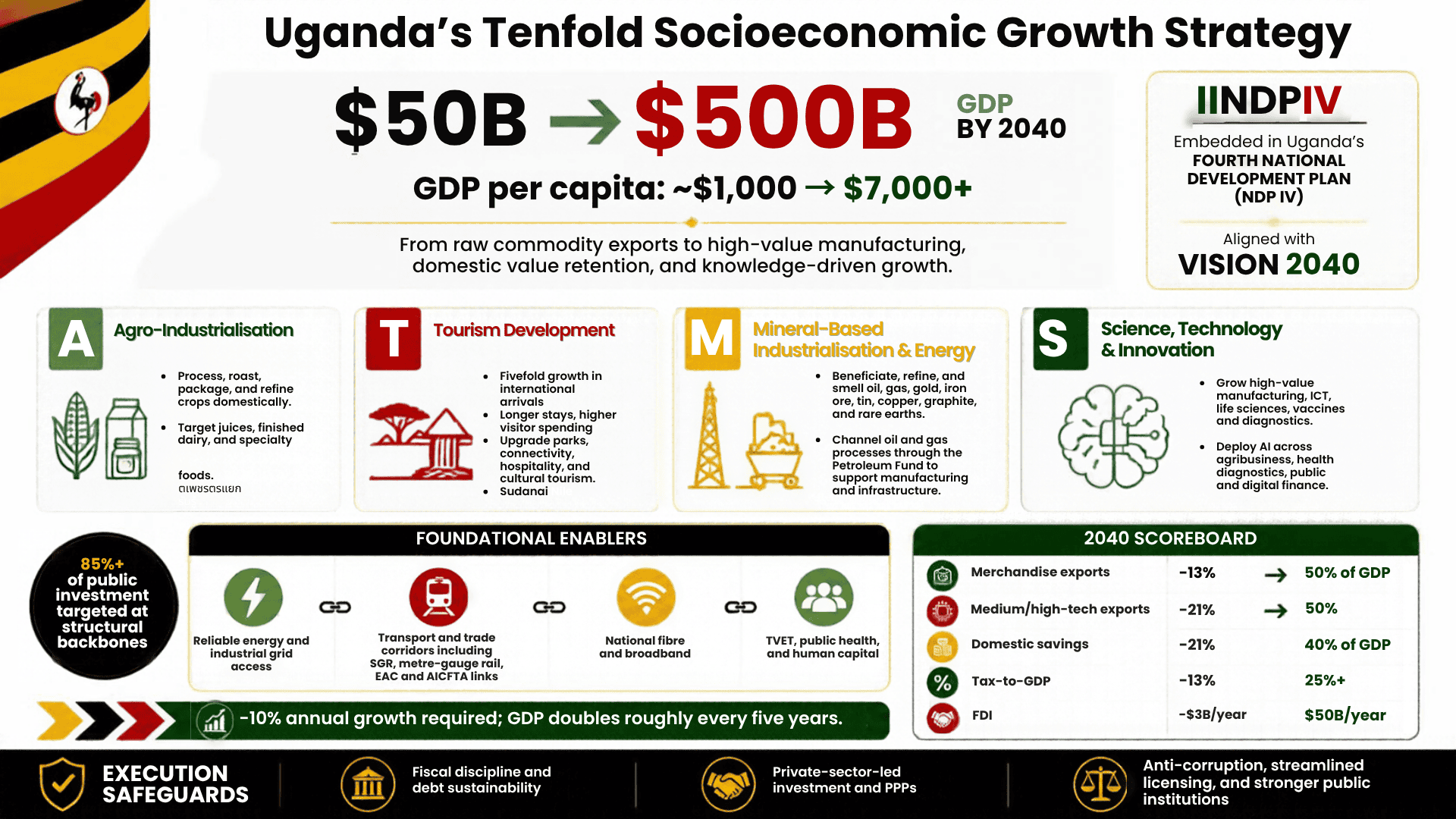
Uganda’s Tenfold Socioeconomic Growth Strategy is designed to expand the national economy tenfold—from approximately $50 billion to $500 billion by 2040, raising GDP per capita from around $1,000 to over $7,000. Embedded primarily within Uganda’s Fourth National Development Plan (NDP IV) and aligned with Vision 2040, the strategy moves away from exporting raw commodities toward high-value manufacturing, domestic value retention, and knowledge-driven growth.
The core framework is structured around four primary growth engines (known as ATMS) supported by macroeconomic and structural enablers
1. The Four Anchor Engines (ATMS)
A – Agro-Industrialisation:
Transitioning commercial agriculture from exporting raw crops (such as green coffee beans, tea, and grains) to domestic processing, roasting, packaging, and refining.
Targeting high-value agro-processing (juices, finished dairy, specialty foods) to build domestic agro-industrial jobs and insulate export earnings from global commodity volatility.
T – Tourism Development:
Targeting a fivefold increase in international visitor arrivals alongside longer stays and higher expenditure per visitor.
Upgrading conservation-grade connectivity, national park infrastructure, regional hospitality services, and cultural tourism offerings.
M – Mineral-Based Industrialisation & Energy:
Developing domestic beneficiation, refining, and smelting for oil, gas, gold, iron ore, and critical transition minerals (such as tin, copper, graphite, and rare earths) rather than exporting raw ores.
Channeling proceeds from upstream oil and gas production into the Petroleum Fund to capitalize domestic manufacturing and physical infrastructure.
S – Science, Technology & Innovation (STI):
Fostering high-value manufacturing, ICT services, and life sciences (including local vaccine and diagnostics production).
Deploying the Uganda AI Vision 2040 framework across agriculture, healthcare diagnostics, public administration, and digital financial systems.
2. Foundational Enablers & Infrastructure
To support high productivity in the anchor sectors, over 85% of public investment under the framework is targeted toward these structural backbones:
Energy Generation & Grid Reliability: Expanding generation capacity and industrial grid access to lower per-unit electricity tariffs for manufacturing hubs and industrial parks.
Transport & Trade Corridors: Standard Gauge Railway (SGR) connectivity, rehabilitation of the metre-gauge railway network, and regional trade corridors linking Uganda with the wider East African Community (EAC) and AfCFTA markets.
Digital Connectivity: Expanding national fiber optic backbones and broadband coverage to support the digital services and fintech sectors.
Human Capital Development: Aligning technical and vocational education and training (TVET) with industrial needs, alongside public health improvements to enhance labor productivity.
3. Macroeconomic Targets & Financial Reforms
Sustaining the ~10% annual economic expansion required to double GDP roughly every five years relies on several financial metrics:
Metric Baseline (approx.) 2040 Target
Gross Domestic Product (GDP) ~$50–$53 Billion $500 Billion
GDP Per Capita ~$1,039 $7,000+
Merchandise Exports (% of GDP) ~13% 50%
Medium/High-Tech Exports ~21% 50%
Domestic Savings Rate ~21% of GDP 40% of GDP
Tax-to-GDP Ratio ~13% 25%+
Foreign Direct Investment (FDI) ~$3 Billion/yr $50 Billion/yr
4. Governance and Execution Preconditions
For the strategy to take effect without triggering macro fiscal stress, the government emphasizes several execution safeguards:
Fiscal Discipline & Debt Sustainability: Prioritizing productive, high-return public assets over recurrent expenditures or speculative construction.
Private-Sector Led Investment: Relying on public-private partnerships (PPPs) and clear regulatory stability to mobilize private capital rather than solely accumulating sovereign debt.
Anti-Corruption & Administrative Coherence: Streamlining bureaucratic licensing and reinforcing institutional capacity across ministries, departments, and agencies (MDAs).
-

Sharing the Blame for Colonialism and Slave Trade
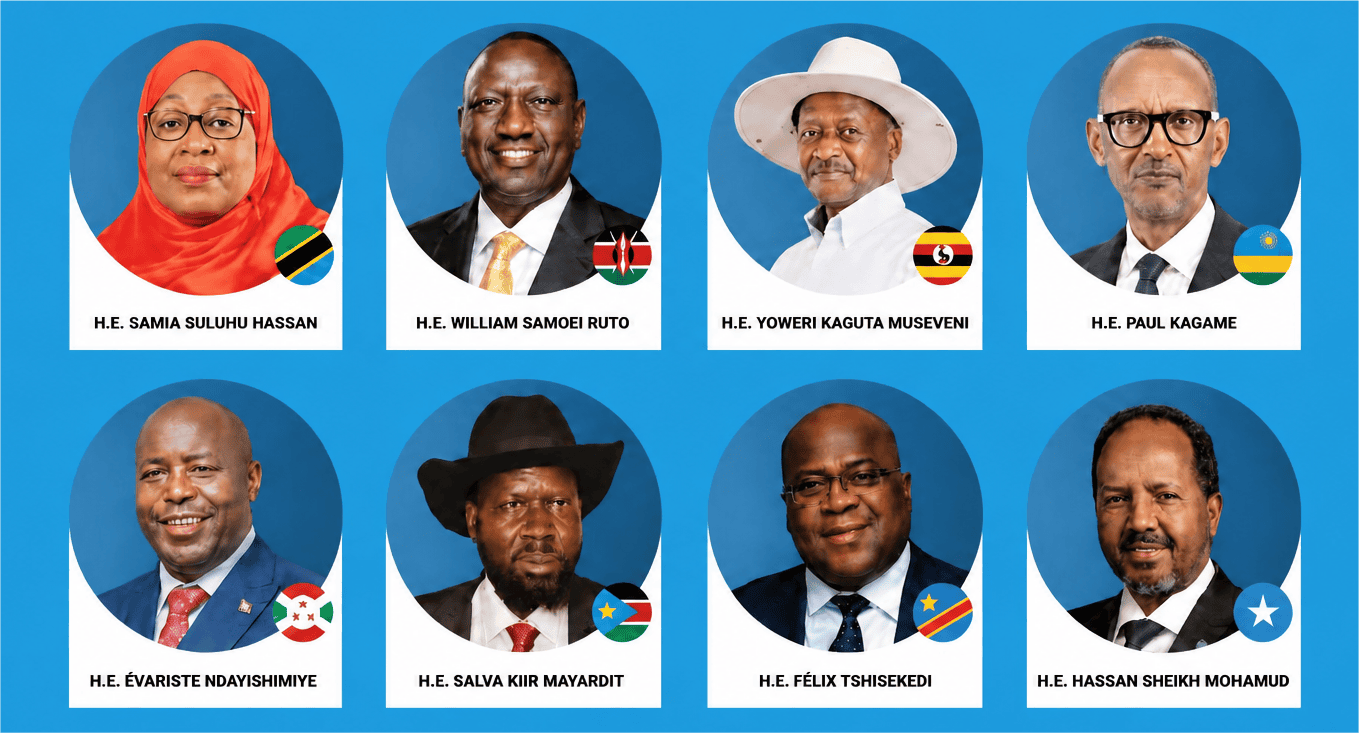
In March, 2026 Uganda took over the rotational chairmanship of the eight-member East African Community (EAC). The Community, as it is popularly referred to by its member states, consists of a belt of African countries across the Great Lakes of Africa: from Mombasa at the Indian Ocean, to Kinshasa on the shores of the Atlantic Ocean. It is a vast area comprising 2,104,147 square miles or nearly 18 per cent of the total land area of the African continent. Its population of some 350 million people, is a rich tapestry of African peoples featuring all the clusters of societies and cultures found in this Mother Continent of Humanity.
Below are excerpts on the problem of weak leadership which precipitated the two evils of colonisation and slave trade and wracked the Continent for centuries, as exposed during his inaugural address by General Yoweri Museveni, President of Uganda and current Chairperson of this regional block.
“By 1900, the whole of the African continent had been colonised, except for Ethiopia which had defeated Italian Imperialists in 1896 at Adoa. This was squarely the fault of African chiefs and kings who had watched the slow encroachment of these European invaders right from the time when the Ottoman Turks captured Constantinople (Istanbul) in 1453, closing the overland route to Asia pioneered by Marco Polo around the years 1271-1295.
“While the Europeans were rightly looking for an alternative route to the East by going around our massive Continent, they became slave traders and colonialists when they discovered the weaknesses created by our Kings – oppressing the people, fighting one another instead of cooperating, failing to adopt new scientific knowledge ( eg gun-powder), etc. Many of them participated in the slave trade, selling our people.
“By 1900, all those African Kings were either dead or captured or had capitulated into subservience. They had squandered the time when they could have done the necessary changes to immunise us against domination. Ever since 1498, when Vasco Da Gama passed by the East African Coast, attacked Mombasa and continued to India, it was a whole 402 years wasted – no scientific innovation, no unity among themselves. They paid for their mistakes – Kabalega, Mwanga, Cetshwayo, Mkwakwa, etc, were either dead or captured. Unfortunately, the whole of Africa also paid by having slaves torn away from their country, freedom hijacked, resources stolen, etc
“While the leadership of Africa has been problematic for centuries, however, the populations are tough, hard-working and wealth-creators for millennia. Unlike the American Indians or Aboriginal Australians, we died during the colonial aggression, but did not perish. Our cattle, goats, sheep, chicken, etc, that stay with us in our huts, had long vaccinated us against the deadly zoonotic diseases (diseases between man and animals) that had exterminated the other indigenous peoples.”
-
M.P. Solomon Ossiya Tasked President to End Teso Karamoja Border Conflicts
Toroma County Member of Parliament Solomon Ossiya has tasked President Yoweri Museveni to spearhead renewed cross-border mediation between the Iteso and Karamojong communities following continued cattle theft, killings and insecurity along the Teso-Karamoja border.
Ossiya made the call on Friday while speaking during the NRM Parliamentary Caucus meeting at Kololo, where he raised concerns over persistent attacks affecting communities in Magoro and Ongongoja in Katakwi District, as well as parts of Kapelebyong and Bukedea.
He said although the government’s disarmament efforts and deployment of security forces have significantly reduced cattle rustling in the region, cattle theft and deadly confrontations continue to occur along the border.
However, the Deputy RDC for Katakwi Xavier Okwi, urged the residents of Katakwi most especially those in the cattle corridor to be vigilant of their animals.
He said that they have informed the office of the president to handle the situation
-
Teso Parish Development Committee Chairpersons Accused of Abusing Restocking Guidelines
The Parish Development Committee Chairpersons in Teso Sub Region have been accused of abusing the guidelines of the Restocking Program.
Christine Apolot, a member of the Presidential Affairs Committee, while chairing an engagement meeting for Soroti, Amuria and Kaberamaido districts at Soroti District Headquarters on Thursday 13th August 2026, noted several loopholes in the selection of beneficiaries.
According to Apolot, some officers fronted their own relatives to benefit from the funds, used the names of elders to access money, and even allowed people from other parishes to benefit.
Apolot expressed gratitude to Soroti and Amuria districts in particular for owning the program and recovering money that had been misappropriated by Parish Development Committees and LC2 Chairpersons.
The Presidential Affairs Committee is on a three-day oversight visit to assess the implementation of the Restocking Program in Teso Sub Region.
Bob Owiny, the LC5 Chairperson of Soroti District, acknowledged the challenges with the Restocking Program but pledged commitment to ensure that the targeted beneficiaries receive the money.
Martine Ojara, Chairperson of the Presidential Affairs Committee, said they will recommend tough action against government officers who mismanage government programs.
-
Residents Urge Katakwi Authorities to Act Over Dangerous Otur Rd
Communities in Ngariam and Omodoi sub-counties in Katakwi District are calling on district authorities to urgently repair the road connecting the two areas, saying its poor condition is making movement difficult and putting lives at risk.
Residents say the road, particularly the section around Otur Swamp, which borders Ngariam and Omodoi sub-counties, has become a hotspot for accidents and deaths due to its poor terrain.
They say two brothers recently lost their lives in an accident at the same location, raising fears that more people could die if urgent action is not taken, especially with the ongoing rainy season.
The residents say the poor road condition is also affecting access to markets, health facilities and other essential services.
They are therefore calling on their leaders to intervene and have the road repaired to improve connectivity and movement of people and goods.
Meanwhile, Lazaro Okori, the LCII Chairperson of Adugulu Parish in Omodoi Sub-county, warns that continued rains could worsen the situation around Otur Swamp and expose road users to more accidents and deaths.
However, Katakwi District LCV Chairperson Geoffrey Omolo has asked residents to remain calm, saying the road is already included in the district’s budget.
Omolo says the government has also surveyed the road and is committed to improving it using a climate-smart approach to make it more resilient to heavy rains.
-
Kumi Deputy RDC Urges Residents to be their Neighbours Keepers Ahead of Independence Day
KUMI-The Deputy Resident District Commissioner (RDC) for Kumi District, Chemutai James Small has urged residents to remain vigilant and work together to maintain peace and security as Uganda prepares to celebrate 64 years of Independence.
Uganda will mark its 64th Independence anniversary on Friday, October 9, 2026, with celebrations expected to take place across the country.
Chemutai, who has served in Kumi District for the past three months, commended residents for their cooperation and called for continued vigilance during the celebrations.
“I want to thank the people of Kumi for the good three months I have served. We are now around the corner to celebrate Independence Day, which will be on Friday, October 9, 2026,” he said.
The Deputy RDC cautioned residents against criminals who may seek to exploit the festivities to commit offences, including burglary and fighting.
“This is a time when many people want to take advantage of these celebrations and embark on dubious activities like robbing people’s homes and fighting,” Chemutai said.
He said sub-county authorities had been directed to strengthen security patrols during the day and night to ensure that residents celebrate in a peaceful environment.
“The sub-counties are now mandated to ensure total security in terms of patrols day and night so that we can have a peaceful celebration,” he said.
Chemutai also called on local council leaders to actively perform their responsibilities as chairpersons of security in their respective areas.
He said LC1 chairpersons at village level, LC2 chairpersons at parish level and LC3 chairpersons at sub-county level, together with other stakeholders, should work closely with security agencies to prevent crime.

MANAGERS PHONE NUMBER 0778173335
STUDIO LINES 0757477254 / 0392894282